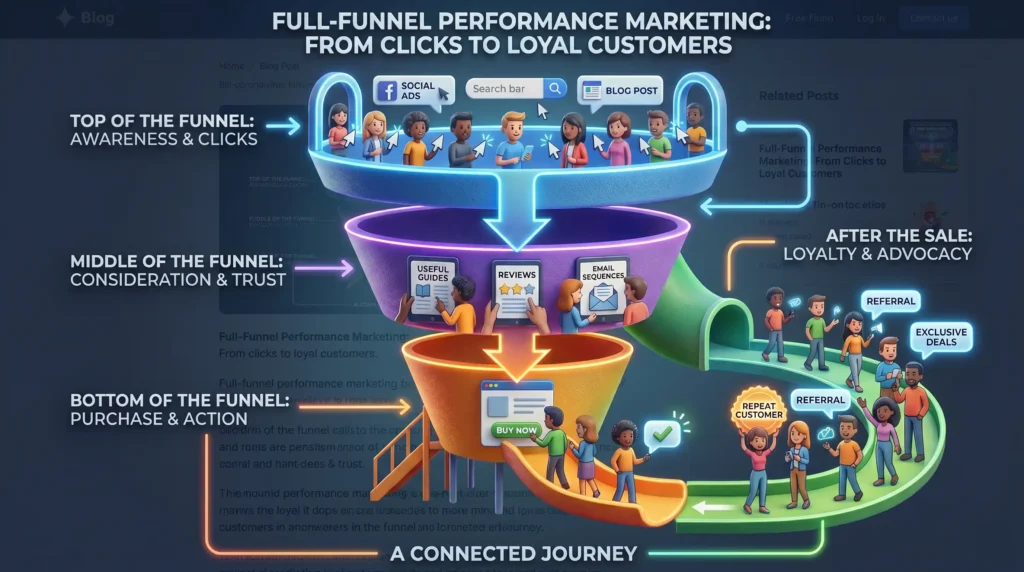
Full-funnel performance marketing is a plan that helps you move people from just clicking on your ad to becoming loyal, repeat customers. Instead of only chasing clicks or one-time sales, you design the whole journey from first look to long-term trust.
What is a Full-Funnel Performance Strategy?
A funnel is a way to describe how many people slowly turn into customers. At the top, many people see you; at the bottom, a smaller number buy and stay with you.
A full-funnel performance strategy means you have a clear plan for every step:
– When people first see you.
– When they think about you.
– When they decide to buy.
– When they come back again.
The Funnel: From Clicks to Customers
Imagine a big slide in a playground. Many kids climb up, fewer go down, and even fewer reach the end. Your marketing funnel is the same:
– At the top, many people see your ad or content and click.
– In the middle, some read more and think about you.
– At the bottom, some buy and become your customers.
Your goal is to guide people all the way down the slide, not just to make them climb up and then stop.
Top of the Funnel: People First See You
At the top of the funnel, people do not know who you are. You want them to notice you and remember your name, not necessarily buy right away.
You can use:
– Social media and video ads to show your brand and what problem you solve.
– Helpful blog posts and basic guides that answer simple questions.
– SEO so people can find you on Google when they search for the problem you solve.
Here you look at reach, views, and clicks to see if people are starting to notice you.
Middle of the Funnel: People Are Thinking
In the middle of the funnel, people are interested but not sure yet. They are comparing you with other options and checking if they can trust you.
You help them by giving more useful, detailed information:
– Deeper blog posts, step-by-step guides, or comparison articles.
– Customer stories and reviews that show results.
– Email sequences or messages that answer common doubts and show how you can help.
Here you check things like time on page, how many people download content or sign up, and how many good leads you get.
Bottom of the Funnel: People Are Ready to Buy
At the bottom of the funnel, people are close to buying. Your job is to make it very simple and safe for them to say yes.
You focus on:
– Clear product pages with strong benefits, pricing, and proof.
– Easy checkout or sign-up forms that do not ask for too much.
– Search ads and remarketing aimed at people who are already close to buying.
Here the main numbers are conversion rate, cost per acquisition, and revenue or ROAS.
After the Sale: Keep Customers Loyal
Full-funnel performance marketing does not stop after the first sale. It also includes keeping customers happy so they stay longer and buy more over time.
You can:
– Send helpful tips and how-to content so they get full value from what they bought.
– Offer special deals or early access to new products for repeat customers.
– Ask for reviews and referrals, turning happy customers into promoters.
Here you look at repeat purchase rate, churn, and lifetime value.
Why Full-Funnel Performance Marketing Works
If you only focus on one part of the funnel, you lose power:
– If you only work at the top, lots of people know you, but few buy.
– If you only work at the bottom, ads can be expensive because not enough people already trust you.
Full-funnel performance marketing works because every stage supports the others:
– Top of the funnel makes people aware and curious.
– Middle of the funnel builds trust and answers questions.
– Bottom of the funnel makes buying easy and clear.
– After the sale, loyalty and referrals reduce your marketing costs over time.
When all stages are connected, your clicks are not just numbers. They are the first step in a system that turns strangers into loyal customers.